Freight Broker vs Best Logistics Company in Canada
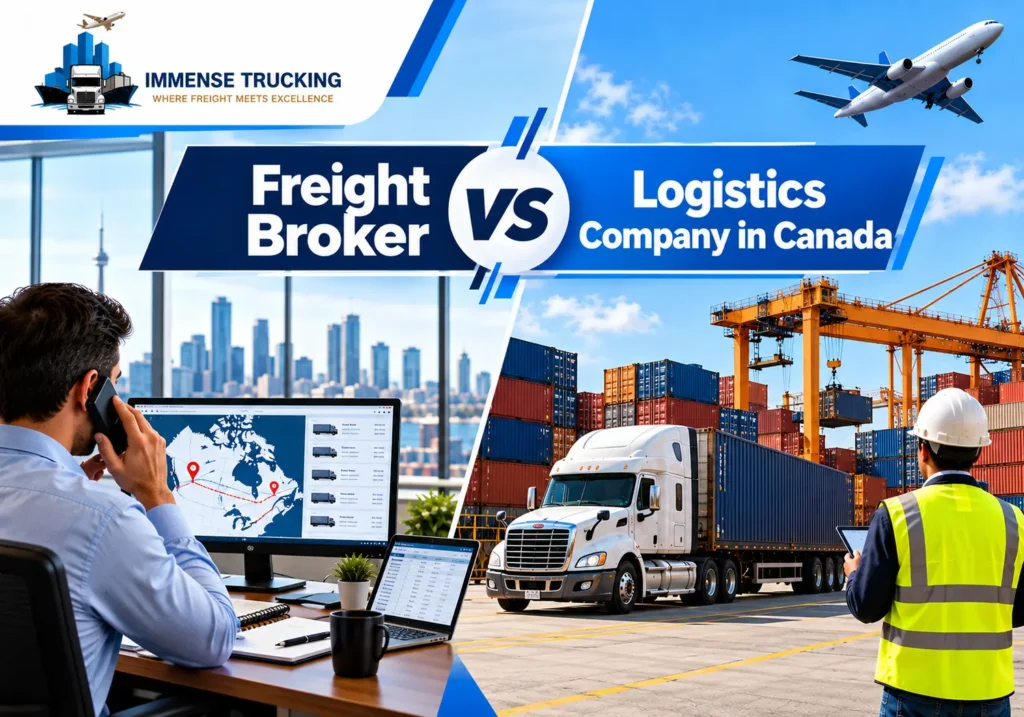
Choosing between a freight broker and a logistics company depends on what a business needs from its transportation partner. A freight broker mainly arranges transportation by connecting shippers with carriers. A logistics company can provide broader support, such as freight planning, transportation coordination, warehousing, drayage, and specialized cargo handling. Therefore, businesses searching for the best logistics company in Canada should compare the scope of service, carrier network, communication, equipment options, and experience with their type of freight rather than choosing based on price alone. What Is the Difference Between a Freight Broker and a Logistics Company? A freight broker acts as an intermediary between a shipper and a carrier. The broker arranges transportation but does not necessarily operate the truck that moves the shipment. In the United States, the Federal Motor Carrier Safety Administration (FMCSA) defines a broker as a party that arranges transportation by an authorized motor carrier for compensation. A logistics company can take a broader role in planning and coordinating freight movement. Depending on its services, it may manage transportation, warehousing, shipment tracking, carrier coordination, intermodal movements, and other supply chain activities. For example, a Canadian manufacturer shipping machinery from Ontario to a U.S. distribution center may need more than a truck. It may also need pickup scheduling, border documentation support, carrier coordination, tracking, and delivery planning. That is where a broader logistics provider can offer value. When Does a Freight Broker Make Sense? A freight broker can be useful when a business mainly needs help finding available truck capacity. For example, a company may have a shipment ready in Toronto but no established carrier for the route. A broker can search its carrier network and arrange transportation that matches the shipment requirements. Brokers can be particularly useful when: A business ships only occasionally Truck capacity is difficult to find The shipper has limited carrier relationships A company needs transportation for a specific lane Freight volumes change from week to week However, the shipper should still ask important questions before booking. These include who will physically transport the freight, what type of equipment will be used, how cargo claims are handled, and who will provide shipment updates. In the U.S., brokers arranging regulated interstate transportation are subject to FMCSA requirements and must work with authorized motor carriers. When Is a Logistics Company a Better Choice? A logistics company may be more suitable when transportation is only one part of a larger supply chain requirement. For instance, an importer may need a container moved from a port to a warehouse, unloaded with the right equipment, stored temporarily, and then delivered to several customers. Managing these steps separately can create communication gaps. A logistics partner can coordinate multiple stages under one transportation plan. This can include: Full truckload (FTL) transportation Less-than-truckload (LTL) shipping Warehousing and distribution Intermodal transportation Drayage services Freight tracking Specialized cargo transportation Cross-border transportation coordination As a result, companies with recurring freight needs may benefit from a logistics relationship instead of arranging every shipment independently. What Should You Look for in the Best Logistics Company in Canada? There is no single company that is automatically the best choice for every shipper. The right provider depends on cargo type, shipping lanes, volume, delivery requirements, and service expectations. 1. Transportation Coverage First, check whether the provider handles the lanes your business actually uses. A company moving freight between Ontario and Michigan has different requirements than one shipping agricultural products from Saskatchewan to British Columbia. Therefore, ask about domestic routes, cross-border capabilities, and access to suitable equipment. 2. Carrier and Equipment Options Equipment should match the shipment. Standard dry vans may work for packaged goods, while refrigerated trailers may be necessary for temperature-sensitive food. Flatbeds can be useful for certain construction materials, while specialized equipment may be required for oversized machinery. A strong trucking solutions company in Canada should understand these differences rather than offering the same transportation method for every shipment. 3. Communication and Tracking Good communication can prevent small transportation problems from becoming expensive delays. Ask how shipment updates are provided and who handles exceptions. A clear process should cover pickup confirmation, transit updates, delivery status, and problems such as delays or damaged freight. 4. Industry Experience Industry knowledge matters when cargo has special handling requirements. For example, construction materials may require careful loading and weight planning. Granite shipments need secure handling because of their weight and shape. Food shipments may require temperature control and reliable delivery windows. The provider should understand the cargo before recommending transportation. How 3PL Logistics Companies in Canada Can Help A third-party logistics provider (3PL) manages selected logistics activities on behalf of a business. Depending on the provider, this can include transportation, warehousing, order fulfillment, freight coordination, and distribution. For a growing business, using one of the many 3PL logistics companies in Canada can reduce the need to manage several transportation suppliers independently. For example, a retailer may use a 3PL to coordinate inbound freight, temporary storage, inventory movement, and outbound deliveries. The exact services vary, so businesses should confirm what the provider actually manages. The main advantage is coordination. Instead of treating each shipment as a separate task, the logistics provider can look at transportation as part of the wider supply chain. Industry-Specific Transportation Needs Different industries require different logistics strategies. Construction Transportation Services Construction companies often move building materials, equipment, tools, and oversized loads between suppliers, job sites, and storage locations. Scheduling is especially important because a delayed delivery can affect work at a construction site. Businesses should therefore choose a provider that understands job-site delivery requirements and equipment limitations. Granite Logistics Services Granite is heavy, valuable, and difficult to handle incorrectly. Transportation planning should consider weight distribution, secure loading, handling equipment, and delivery access. For this reason, granite logistics services require more planning than ordinary palletized freight. Agriculture Transportation Services Agricultural freight can involve seasonal volumes, strict delivery windows, and temperature-sensitive products. Depending on the commodity, businesses may need refrigerated transportation, dry freight equipment, or specialized loading arrangements. Reliable