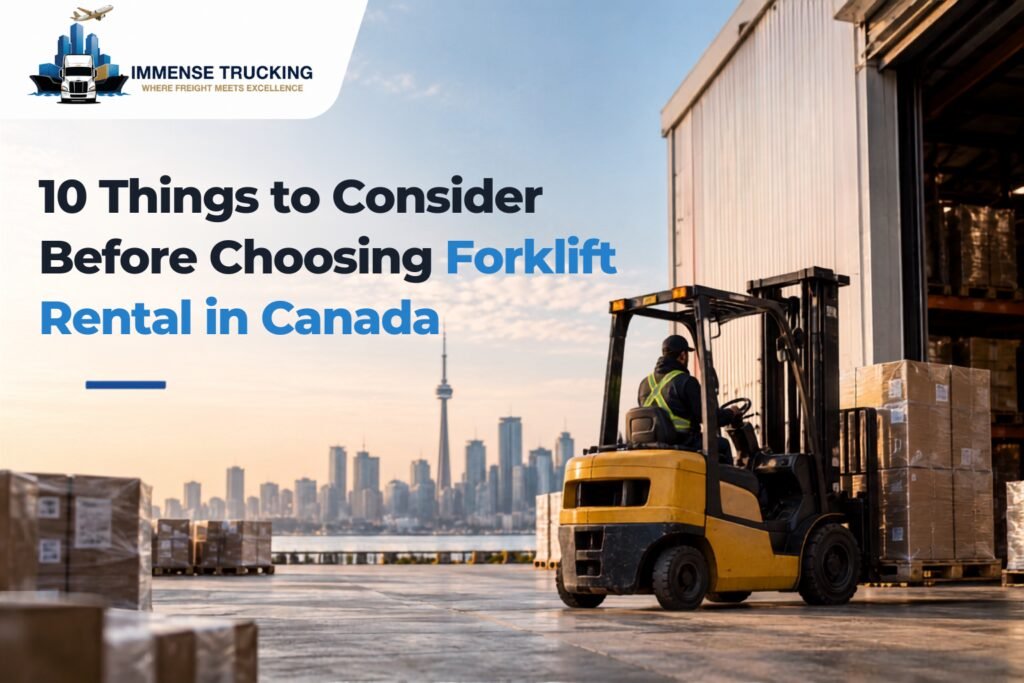
10 Things to Consider Before Choosing Forklift Rental in Canada
Introduction Choosing the right forklift rental in Canada can make daily warehouse and material-handling work easier, safer, and more efficient. Whether you need a forklift for a short project, seasonal demand, construction work, or regular warehouse operations, selecting the right equipment matters. A suitable rental can help reduce upfront costs while giving your team access to equipment that matches the job. However, not every rental provider offers the same equipment, service, or support. Therefore, businesses should carefully compare their options before making a decision. From forklift capacity and safety checks to rental terms and maintenance, several factors deserve attention before signing a rental agreement. Forklifts play an important role in warehouses, distribution centers, manufacturing facilities, construction sites, and logistics operations. They help businesses move pallets, materials, machinery, and other heavy loads efficiently. However, choosing a forklift without understanding your operational requirements can create unnecessary costs and safety concerns. For this reason, businesses should look beyond the rental price. Instead, they should evaluate the equipment, rental company, service quality, and overall value. The following ten considerations can help you choose a forklift rental that fits your business needs. 1. Understand Your Forklift Requirements Before searching for a forklift rental in Canada, identify exactly what you need the equipment to do. Different jobs require different forklift types, capacities, and attachments. For example, a warehouse may need a compact forklift for narrow aisles, while a construction project may require a heavy-duty machine for larger materials. Similarly, outdoor operations may require equipment designed for uneven surfaces. Consider the following factors: Type of material you need to move Average and maximum load weight Required lifting height Indoor or outdoor operation Available working space Surface and terrain conditions Expected hours of operation Required forklift attachments By understanding these requirements first, you can avoid renting equipment that is either too small for the job or unnecessarily large and expensive. 2. Check Load Capacity and Lift Height One of the most important factors is the forklift’s load capacity. Every forklift has a specific weight limit, and exceeding it can affect stability and safety. Therefore, calculate the maximum weight your team expects to lift. Also, consider the dimensions and shape of the loads. A forklift must be capable of handling the load safely at the required lifting height. In addition, check the manufacturer’s capacity rating. The rated capacity can change depending on lift height, attachments, and load positioning. Consequently, choosing equipment based only on its basic capacity may not be enough. A reliable rental provider should help you select equipment based on your actual operating conditions. 3. Evaluate the Condition of the Equipment Equipment condition should be a major consideration when choosing forklift rental in Canada. A lower rental price may not provide good value if the forklift frequently breaks down or requires repairs. Before accepting the equipment, inspect important components such as: Tires and wheels Forks and mast Hydraulic system Brakes Steering Safety lights Warning alarms Seat belt Battery or fuel system Operator controls Look for visible damage, fluid leaks, worn components, or unusual noises. Furthermore, ask whether the forklift has received regular inspections and maintenance. Well-maintained equipment can reduce unexpected downtime and help your team complete work more efficiently. 4. Review Safety Features Safety should always come before price. Forklift operations can involve heavy loads, moving vehicles, pedestrians, and restricted warehouse spaces. Therefore, the equipment should include appropriate safety features and be suitable for the working environment. Depending on the model, useful features may include: Seat belts Safety alarms Warning lights Overhead guards Backup alarms Good visibility Stable mast systems Operator-friendly controls Additionally, operators should understand safe forklift practices before using the equipment. A responsible rental provider can explain the equipment’s operating requirements and safety considerations. As a result, businesses can create a safer work environment while reducing avoidable operational risks. 5. Compare Rental Costs and Terms Price is important, but it should not be the only deciding factor. When comparing forklift rental in Canada, examine the complete rental agreement rather than focusing only on the advertised daily or monthly rate. Check whether the quoted price includes: Delivery and pickup Maintenance Repairs Replacement equipment Insurance requirements Operator support Additional attachments Overtime charges Damage fees Also, understand the rental duration. Short-term and long-term rentals may have different pricing structures. Therefore, calculate the total expected cost before making your decision. A slightly higher rental price can sometimes provide better value when maintenance, transportation, and support are included. 6. Consider Forklift Service and Maintenance Support Reliable service is especially important when the forklift is needed for daily operations. Equipment downtime can delay warehouse activities, construction projects, and delivery schedules. When comparing providers, ask about their forklift service in Canada and maintenance processes. Find out how quickly they respond when equipment develops a problem. A good provider should have a clear process for: Routine maintenance Emergency repairs Equipment inspections Technical support Replacement equipment Service scheduling Moreover, ask who is responsible for maintenance during the rental period. Clear responsibilities can prevent disagreements later. If your operation depends heavily on the forklift, responsive service can be just as valuable as the equipment itself. 7. Check Delivery and Transportation Options Getting the forklift to your location safely is another important consideration. Depending on the machine’s size and weight, specialized transportation may be required. Ask the rental provider whether delivery and pickup are included. Also, confirm the expected delivery schedule and transportation requirements. Businesses that regularly move heavy equipment can benefit from professional forklift transport in Canada. Proper transportation helps reduce delays and ensures equipment reaches the job site safely. Furthermore, companies that provide or coordinate transportation may offer a smoother rental experience because fewer third parties are involved. 8. Choose a Provider With Logistics Experience A rental company with strong logistics knowledge can better understand the challenges involved in moving and handling equipment. This can be particularly helpful for warehouses, distribution centers, construction projects, and industrial businesses. For example, a logistics warehouse company in Canada may understand warehouse layouts, loading requirements, storage systems, and material-handling processes. This